Toegang tot Innovatie
 Toegang tot Kapitaal
 Toegang tot Talent
 Toegang tot Markt
 Toegang tot Kennis

“Effective cybersecurity cannot be achieved alone” - Interview with Joris den Bruinen

Mission of HSD
The mission of the HSD Foundation is to enhance digital security and economic growth through (innovation-driven) collaboration between public and private stakeholders.
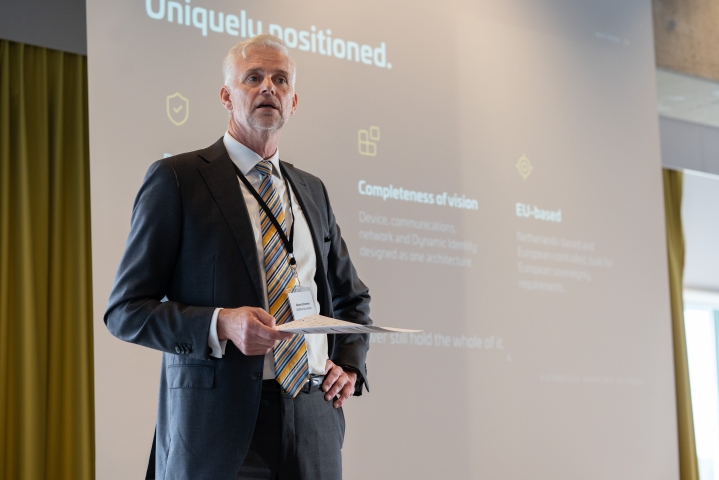
“We ensure that an ecosystem of currently 300 partners continues to develop and generate impact,” explains Joris. “Strengthening effective cybersecurity is not something you can do alone. It is simply too complex and too dynamic. It requires a combination of organisational and technical measures, empowered employees, and a clear understanding of the value chains you are part of. By fostering collaboration and innovation and by carrying out a wide range of activities, we help keep the system running. Providing access to knowledge, innovation, funding, talent and international markets has been central to our work since the very beginning. In addition, we deliver substantive innovation programmes.”
Digital sovereignty
Joris illustrates this complexity with a topical example. “Digital sovereignty is now high on the agenda. Government, industry, as well as sectors such as education and healthcare, all recognise the importance of addressing this issue.”
On the surface, it sounds straightforward: something is important, it is placed on the agenda, solutions are identified and implemented. “However, that is not how it works in this case,” Joris explains. “Digital sovereignty has a broad impact across the entire technology stack, from IT to AI, and from risk management to procurement. It affects both business operations and core processes. For decades, we have operated in a culture of efficiency and ‘just-in-time’ supply chains, which means we first need to rethink our approach before we can translate it into action.”
HSD encourages this shift towards risk-based, strategic thinking and decision-making. “When this becomes the starting point, reducing dependencies through a solid analysis of processes and business operations becomes the foundation for addressing digital sovereignty.”
“One of the deeply embedded practices that emerges in this context is the traditional pursuit of the cheapest and most user-friendly solution. This has led to what we now refer to as ‘undesirable dependencies’. These, in turn, raise questions around risk and vulnerability. We therefore need to move away from purely efficiency-driven thinking towards a risk-based approach. This is not something that can be achieved overnight; it starts with awareness, followed by collaboration, better alignment between supply and demand, and integrating sovereignty into decision-making processes.”
In this role, HSD acts as a facilitator of dialogue and translates it into actionable perspectives, for example through cyber resilience initiatives and programmes such as ‘Smart Secure Cities’ and ‘AI & Security, Peace and Justice’.
‘Secure by design’ and the energy transition
A second key priority for HSD, its partners and policymakers is embedding the ‘secure by design’ principle from the outset within the energy transition and high-tech manufacturing supply chains, rather than addressing digital sovereignty and cyber resilience afterwards.
“The Cybersecure Energy Transition Innovation Coalition is a clear example of effective collaboration,” says Joris. “The digitalisation of the grid and local energy hubs, along with improved demand and supply matching, are essential components of the energy transition and solutions to grid congestion. This involves not only supply chain collaboration and technical OT/IT integration, but also governance, risk management, legal considerations and cybersecurity.”
Within this coalition, HSD brings together a wide range of stakeholders, including grid operators, companies developing Energy Management Systems, secure-by-design IoT platforms and integrator solutions, cybersecurity firms, knowledge institutions and government bodies. Multiple concrete projects are being initiated under this coalition, all based on the secure by design principle. In this way, future cybersecurity risks and vulnerabilities in internet-connected products within the energy chain are addressed at an early stage.
The first projects have already started, supported by more than €3 million in public and private investment. HSD also leverages existing field labs such as The Green Village in Delft, the Duurzaamheidsfabriek in Dordrecht, and Living Lab Scheveningen.
“This approach could serve as a blueprint for launching additional programmes that integrate digital security from the very foundation,” Joris notes. “Such as within the Brabant House of Cyber, focused on high-tech supply chains. It also aligns with the ambition for the Netherlands to position itself as an exporter of cybersecurity solutions and to strengthen digital sovereignty. Last but not least, this innovation is deliberately linked to market and procurement agendas of government, critical infrastructure and large enterprises in order to maximise economic impact.”
Supply chain challenges and complex collaboration
In line with its mission, HSD plays a role in addressing supply chain challenges and complex forms of collaboration. The two examples highlighted by Joris illustrate the need for a different way of thinking in order to understand and tackle today’s challenges.
“Cybersecurity affects all sectors, including IT, operational technology (OT), manufacturing, energy and horticulture. The scope is extremely broad, and collaboration is an absolute prerequisite for progress. In this sense, economy and digital security are two sides of the same coin.”
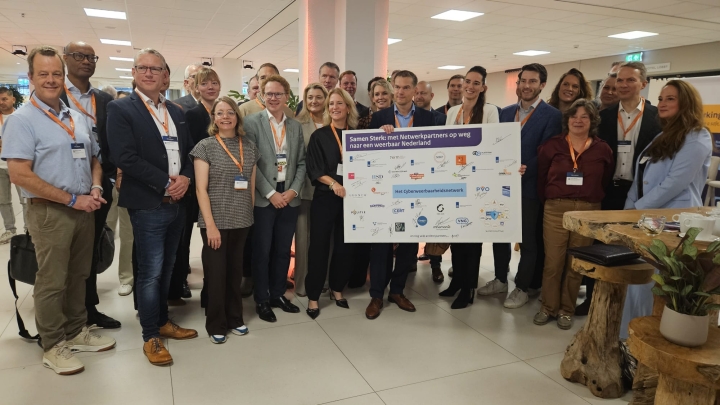
HSD maintains close relationships with a wide range of organisations. At national level, this includes bodies such as the NCSC, the National Police and the Ministry of Economic Affairs, as well as sector-specific organisations such as Greenport West-Holland, HiDelta, the Topsector Energy programme and FME. Regional partners include InnovationQuarter, FERM, the Cyber Resilience Centre Brainport and the Centre for Security and Digitalisation. “We exchange ideas, participate in initiatives and take part in each other’s activities,” Joris concludes.
Cybersecurity events and presence at exhibitions
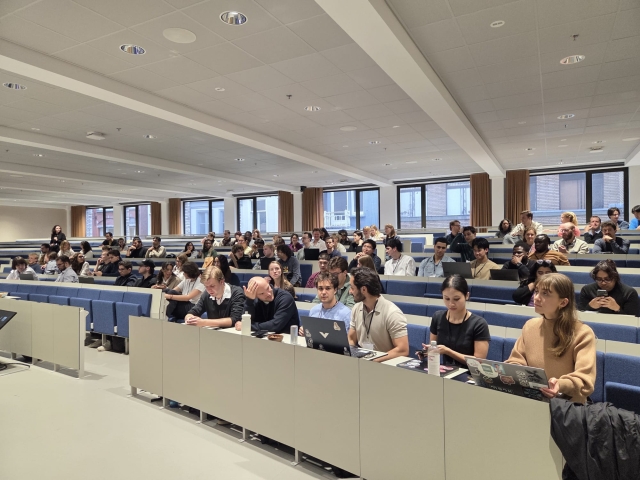
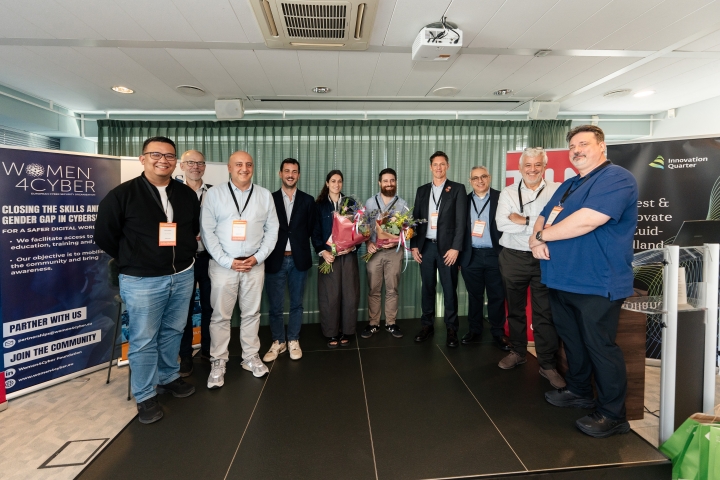
Not everyone regularly encounters HSD or can clearly define what the organisation does. However, readers may have seen HSD at Cybersec Netherlands 2025. HSD is also actively involved in external events. This year again, HSD is a key partner of Cybersec on 9 and 10 September at the Jaarbeurs Utrecht, where HSD partners will be present at the HSD Pavilion.
Last year, HSD participated in a total of 52 external cybersecurity events, both nationally and internationally. At these events, HSD shares knowledge and connects partners, contributing to knowledge exchange, collaboration and the strengthening of the Netherlands’ digital resilience.