Toegang tot Innovatie
 Toegang tot Kapitaal
 Toegang tot Talent
 Toegang tot Markt
 Toegang tot Kennis

HSD Exploration Report Quantum Technology: A Game-changer for Security, Innovation, and Collaboration

Quantum technology is sparking a digital revolution. Although the underlying science has been known for decades, recent breakthroughs are rapidly increasing its practical relevance across sectors such as sensing, communication, and computing. In 2024, a milestone was reached with the development of a quantum computer featuring 100 logical qubits, bringing us closer to systems that could significantly impact security, the economy, and society.
These developments present both opportunities and risks. On one side, quantum technology enables breakthroughs such as ultra-fast and inherently secure communication. On the other hand, it threatens today’s cybersecurity systems by potentially breaking the cryptographic standards that currently safeguard our digital infrastructure. For example, in the United States, new legislation now mandates federal agencies to be quantum-resilient by 2035, illustrating the pace of progress.
The Netherlands has the ambition to become a leading knowledge hub in the field of quantum. With a strong and growing ecosystem in South Holland, this ambition is within reach. To protect our critical infrastructure against the quantum threat, while also leveraging the opportunities that it presents for new capital, talent, market, and innovations, the Netherlands must take unified action. 2025 is the International Year of Quantum Science and Technology according to UNESCO, which shows that there is significant traction to engage with the quantum ecosystem.
Quantum Exploration: From Awareness to Action
To support this effort, the Province of South Holland commissioned Security Delta (HSD) to explore the potential and impact of quantum technology. In preparation for this, HSD conducted a preliminary study in 2024, analysing relevant literature and engaging in strategic conversations with key stakeholders, including the Province of South Holland, the Municipality of The Hague, Q*Bird, Quantum Delta NL, InnovationQuarter, and the Ministry of the Interior and Kingdom Relations. Key insights from the 2024 pre-study include:
- Momentum is growing: The Dutch quantum ecosystem is expanding, with South Holland emerging as a promising hub.
- Initiatives are in place: Multiple efforts are already fostering innovation, cooperation, and outreach.
- Awareness remains a challenge: Due to its complexity, quantum technology remains difficult to communicate, particularly to non-expert audiences.
- Actionable tools are needed: Stakeholders expressed a need for clear guidelines and practical tools to move from awareness to action.
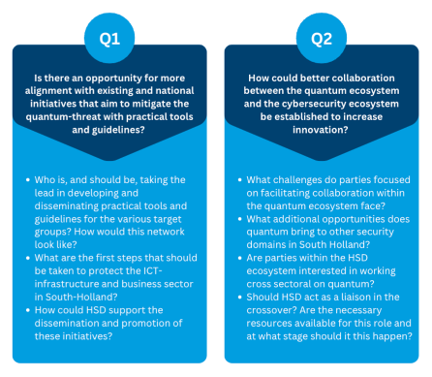
To address these challenges, a coordinated approach is needed, one that combines awareness-building with concrete steps and shared responsibilities. These discussions led to two central research questions for the exploration in 2025, designed to guide action and alignment within the ecosystem. It is crucial to assess where HSD could add value. Only the intersection where quantum and security converge falls within HSD’s scope. The first question focuses on mitigative measures against the threat of quantum computers, whereas the second question examines the prospects for crossovers between the quantum and cyber fields.
*
Findings of the Quantum Exploration
To answer the exploration's research questions, HSD expanded its network and held discussions with relevant stakeholders. An overview of these stakeholders can be found in the report written on the quantum exploration. HSD also organised an HSD Café on quantum technology in June 2025, focusing on quantum from a communication perspective to raise awareness and create a sense of urgency. During the latest HSD Café, experts and stakeholders came together to explore the strategic position of the Netherlands in the quantum ecosystem, the urgency of transitioning to post-quantum cryptography, and the challenges and opportunities that lie ahead for public and private organisations. The session highlighted the importance of European alignment, resilient supply chains, and proactive migration strategies to ensure digital trust in a quantum future.
To answer the first question of the quantum exploration, we first need to distinguish between different organisations. Full migration will not be necessary for the upcoming years for some businesses, but companies and organisations must start taking the first steps. Awareness should therefore be raised systematically from multiple angles. However, the next steps differ for each stakeholder and should be implemented in phases. For instance, product developers should start testing new products in test environments provided by national and local governments, while SMEs should then be encouraged to start conversations with their IT suppliers.
Based on HSD’s expertise and the conversations held, the following steps have been observed to reach post-quantum security in a general sense, considering the threats of quantum computing:
- Enlarging basic cybersecurity levels
- Raising awareness and providing clear action perspectives
- Implementing no-regret moves
- Implementing PQC migration handbook
- Reaching crypto agility
- Standardisation & implementation of QKD (more information to be found in the report)
To address the second question in our exploration of quantum technologies, discussions with our network were essential to understand the opportunities and challenges they face. There are significant opportunities to enhance collaboration within the quantum ecosystem. One effective way to achieve this is by establishing connections across different sectors. Many companies within the HSD network are keen to collaborate with quantum organisations, and vice versa. However, the practical aspects of such cooperation often remain unclear.
The primary challenge in promoting collaboration between the quantum and cybersecurity fields is the lack of urgency, funding, and skilled personnel on the cybersecurity side. Additionally, there is a scarcity of security proofs and certified standards for newly developed quantum systems. Despite these challenges, stakeholders believe there are opportunities for companies willing to invest in tools that focus on implementing Post-Quantum Cryptography (PQC) measures and mapping their cryptographic assets.
Security Delta’s approach to quantum technology
Throughout this exploration, HSD has sought opportunities to add value. One key area is enhancing basic cybersecurity levels across society, particularly through the cyber resilience centers that HSD supports in various sectors. Increasing awareness about the importance of post-quantum measures is another achievable goal. However, merely holding isolated awareness sessions will not lead to meaningful behavioral change; follow-up and practical support are essential. This process requires time, effort, and structured financial backing.
One lesson HSD has learned over the years is that general awareness sessions often do not yield the desired outcomes. Instead, action-oriented activities that provide concrete steps for initiating the post-quantum journey are more effective in creating momentum for change. Additionally, when building a movement, organising a comprehensive programme proves to be more effective than hosting stand-alone events. To implement these initiatives, funding is necessary.
The partners of HSD are mainly tech-oriented and cybersecurity-related. The main attention of HSD, therefore, lies with the ‘threat-side’ of quantum, focusing on the importance of PQC for immediate mitigation of risks. Increased awareness of the quantum threat will likely also benefit the quantum industry. One of the main fields where innovations between cyber and quantum can emerge is in Security by Design/Smart Grids. Projects that are created now must last for decades. Quantum security needs to be integrated into the core of these projects. 
The primary strength of HSD lies in its ability to act as a bridge-builder between various companies and organisations in the quantum and cybersecurity ecosystems. When companies have questions about their transition to post-quantum cryptography (PQC), HSD knows exactly who to connect them with. While HSD can inform and refer interested companies to one another, it lacks the necessary programmes and funding to initiate these connections independently. HSD is capable of conveying the importance of becoming quantum-ready while also emphasising the need to achieve desired cybersecurity levels first.
It’s important to note that migrating to PQC and potentially later to quantum key distribution (QKD) is not solely a cybersecurity issue; it involves process management and the people involved as well. Consequently, achieving post-quantum maturity is a long-term project that must begin today. Let’s innovate together!
Report
The report Quantum Exploration 2025: Assessing the threats & opportunities of quantum technology for the Dutch digital ecosystem, prepared by Security Delta (HSD) on commission of the Province of South Holland (with subsidy from the Province of South Holland) and in cooperation with the Municipality of The Hague and InnovationQuarter, shows that South Holland has realistic opportunities to become a central hub for quantum technology, but only if action is taken now.
Key Findings:
Threats: The arrival of quantum computers poses risks for current cryptography. Early migration to Post-Quantum Cryptography (PQC) and strengthening of basic cybersecurity are essential. Key steps include:
1. Raising the baseline of cybersecurity
2. Increasing awareness combined with actionable guidance
3. Implementing *no-regret moves*, such as mapping cryptographic assets
4. Applying the PQC migration handbook with practical support
5. Developing crypto-agility
6. Preparing for Quantum Key Distribution (QKD) through standardisation and pilots
Opportunities: Stronger cross-sectoral collaboration between the quantum and cybersecurity ecosystems is possible. This requires practical tools, recognised standards, and greater urgency among both public and private stakeholders.
HSD sees its role primarily as a bridge-builder between these worlds, supporting awareness and strengthening cybersecurity foundations. The objective is to prepare businesses and governments to become ready for quantum technologies on time.
Betrokken HSD partners