Access to Innovation
 Access to Capital
 Access to Talent
 Access to Market
 Access to Knowledge

Cybersecure Energy Transition

Smart Technology as the Driving Force Behind the Energy Transition
Around 800 organisations in the Netherlands are working on the energy transition – from operators of electricity networks, solar farms, windturbines and heat grids to manufacturers and suppliers of batteries, transformers and charging stations. Energy chains – the path energy takes from generation to end use – rely on a complex interplanay of hardware, software and infrastructure.
New digital technologies – such as smart grids, the Industrial Internet of Things (IIoT), artificial intelligence, cloud solutions and digital twins – have the potential to make the energy system more efficient, manageable, and affordable. For example, by matching energy supply and demand in real time, and detecting and resolving disruptions more quickly.
A Structural Approach to Cybersecurity in the Energy Chain is Essential
Alongside opportunities, digitalisation also brings risks. Without sufficient focus on cybersecurity and interoperability, energy chains become vulnerable – for example, to cyberattacks on smart grids or manipulation of data exchange. Such incidents can lead to large-scale power outages, economic damage and a loss of control over vital infrastructure. In that case, digitalisation could actually slow down the energy transition and pose a direct threat to economic growth, innovation and energy security.
And there are additional barriers to achieve a cybersecure energy transition. The new Cyber Resilience Act (CRA) imposes strict cybersecurity obligations on manufacturers of hardware and software that can, directly or indirectly, connect to networks and devices. From secure-by-design principles and continuous updates to product classification and certification: each product must be assessed and secured throughout its entire lifecycle, under strict enforcement and reporting requirements. Many suppliers in the energy chain are not yet adequately prepared for this.
Cybersecurity is often viewed as a cost rather than an investment, resulting in underinvestment in structural solutions. In addition, organisations often face limited innovation capacity and adoption barriers. For the sake of maintaining energy supply security, testing or experimentation within existing power networks is typically avoided. Moreover, the sector relies heavily on foreign (non-EU) cybersecurity solutions, which raises concerns around digital autonomy and strategic independence.
Secure by design as a prerequisite for a safe and reliable energy supply
Eleven Dutch organisations are now calling for long-term investment in a cybersecure energy transition over the next decade. Cybersecurity must not be an afterthought or the final item on the budget – it should be an integral part of the design of networks, products, and systems from the outset. Secure by design and interoperable – that is the key to reducing cyberattacks, minimising disruptions, and ensuring secure and reliable data exchange between producers, grid operators, and users. These are essential conditions for a cybersecure energy transition.

South Holland takes the lead in a cybersecure energy transition
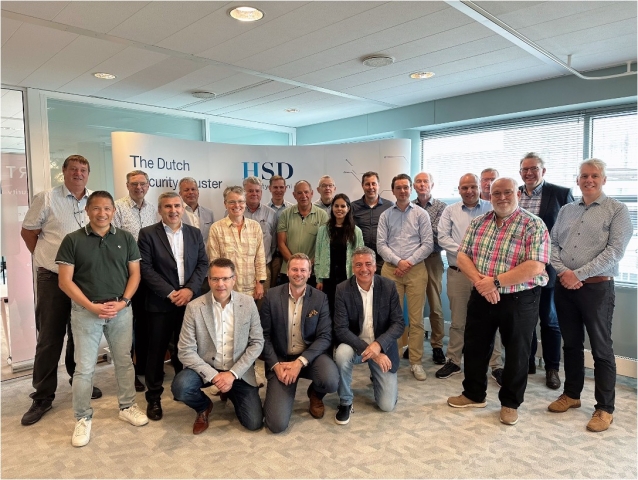
This is an international challenge that calls for joint solutions. No single party can tackle it alone. That’s why, from 8 July 2025, grid operators, industry, knowledge institutions, governments –and more, are joining forces in the Innovation Coalition for a Cybersecure Energy Transition. Their shared goal: to position South Holland at the forefront of a ‘secure by design’ energy system – and to successfully market this knowledge and expertise across the Netherlands and Europe.
South Holland is exceptionally well positioned to seize the opportunities of the energy transition. The region has all the right ingredients: leading knowledge institutions, a strong industrial base, an innovative energy infrastructure, advanced lab and testing facilities, ethical hackers, powerful public-private partnerships and international connections.
From testing to scaling up: building secure and profitable energy chains
The coalition will initially focus on secure-by-design smart grids and energy chains, including unlocking investment and financing opportunities. From testing in (field) labs to real-world applications: translating knowledge into innovation and scaling it into viable business models. This paves the way for societal renewal with tangible economic impact.
The intended long-term outcome of the collaboration includes that energy companies, grid operators, and suppliers will routinely use cybersecure products that comply with EU regulations, such as the Cyber Resilience Act. This will lead to increased availability of certified and secure solutions for smart energy networks, energy storage systems, and digital platforms for demand and supply management. Through joint development and knowledge sharing, cybersecurity solutions should be adopted more rapidly across energy infrastructures, including by system integrators and smaller companies. By embedding cybersecurity into standard components and software, these solutions should also become accessible and affordable for SMEs. Ultimately, this should result in a safer and more reliable energy system, in which end users and business customers have confidence, supported by recognized and certified cybersecurity standards.
Joining forces: grid operators, industry, government and knowledge institutions
The coalition was founded by Batenburg Techniek N.V., Economic Board Zuid-Holland, InnovationQuarter, KPN, Provincie Zuid-Holland, Security Delta (HSD), Stedin, Technolution, TNO, The Green Village & TU Delft in collaboration with the Port of Rotterdam, Westland Infra, DIVD Dutch Institute for Vulnerability Disclosure, European Network for Cyber Security, Greenport West-Holland, Topsector ICT, Gemeente Den Haag, TU Delft PowerWeb Institute, Living Lab Scheveningen, Campusatsea, Hi Delta and Duurzaamheidsfabriek.

Activities & Projects:
- Hack the Power Grid (25 Nov & 4 Dec 2025) - Innovation Coalition present & endorsing partner communications
- Dutch Power Event (10 March 2026) - Innovation Coalition keynote
- Dutch eFORT demo workshop: Cyber Resilient Power Grids (10 June 2026)
HSD Partners involved