Access to Innovation
 Access to Capital
 Access to Talent
 Access to Market
 Access to Knowledge

Date Trend snippet:
12 June 2021
Relevance date:
2018, 2020
Type of Treath or Oppertunity
Domain of application
Source of threat
The HSD Trendmonitor is designed to provide access to relevant content on various subjects in the safety and security domain, to identify relevant developments and to connect knowledge and organisations. The safety and security domain encompasses a vast number of subjects. Four relevant taxonomies (type of threat or opportunity, victim, source of threat and domain of application) have been constructed in order to visualize all of these subjects. The taxonomies and related category descriptions have been carefully composed according to other taxonomies, European and international standards and our own expertise.
In order to identify safety and security related trends, relevant reports and HSD news articles are continuously scanned, analysed and classified by hand according to the four taxonomies. This results in a wide array of observations, which we call ‘Trend Snippets’. Multiple Trend Snippets combined can provide insights into safety and security trends. The size of the circles shows the relative weight of the topic, the filters can be used to further select the most relevant content for you. If you have an addition, question or remark, drop us a line at info@securitydelta.nl.
Please expand your browser window.
Or enjoy this interactive application on your desktop or laptop.
While searching for partners and new markets outside the Netherlands, Compumatica Secure Networks came into contact with HSD. As an HSD partner, this company is now a participant in the programme “Partners for International Business Japan: Cyber Security”. ‘It’s not as if new orders start flooding in after one trip.
Dutch companies and knowledge institutions are working together withina consortium in order to position the Netherlands as a country that can ensure the cyber safety of Japan’s vital infrastructure during the 2020 Olympic and Paralympic Games in Tokyo. The consortium emphasises the importance of pro- tecting the energy, drinking water, and telecom sectors. The digital security of financial services and autonomous vehicles is also an important topic. In 2016, within the framework of the Partners for International Business (PIB) programme, the consortium members sign a partnership agreement with the Netherlands Enterprise Agency (RVO).
Trade mission
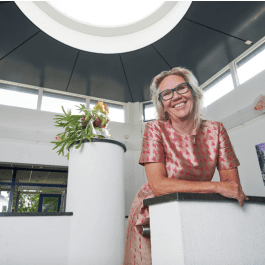
‘The initiative for PIB Japan was born four years ago during a trade mission to Japan’, explains CEO Petra van Schayik. ‘The trip was so interesting that a number of companies decide to start a PIB together with the RVO. Co-participant Alliander writes a collective proposal. The RVO approves it, and in 2016 we end up signing the official partnership agreement, which is accepted by the RVO. As a result, we have an effective organisation in the Netherlands as well as in Japan that supports our PIB. That is of the utmost importance. HSD has an important coordinating role in this regard. You simply need a party that serves as a link between all the organisations and facilitates collaboration.’
. . .
Participating in the PIB requires a commitment in terms of time.
When asked what things companies with international ambitions should take into account, Van Schayik has a clear and simple answer: ‘Don’t be in a rush. Dutch entrepreneurs often want to achieve results very quickly, but in other cultures, especially when it involves cybersecurity, doing business demands a great deal of time. One of the reasons is that you need to build trust. Organisations that wish to start a PIB or to participate in such a programme should realise that it requires a great deal of time and investments, without any guarantee that the goals set out beforehand will actually be realised. ‘So, don’t think that new orders will start flooding in after one trip.’