Access to Innovation
 Access to Capital
 Access to Talent
 Access to Market
 Access to Knowledge

ARMA: Breaking the Mobile Tracking Chain

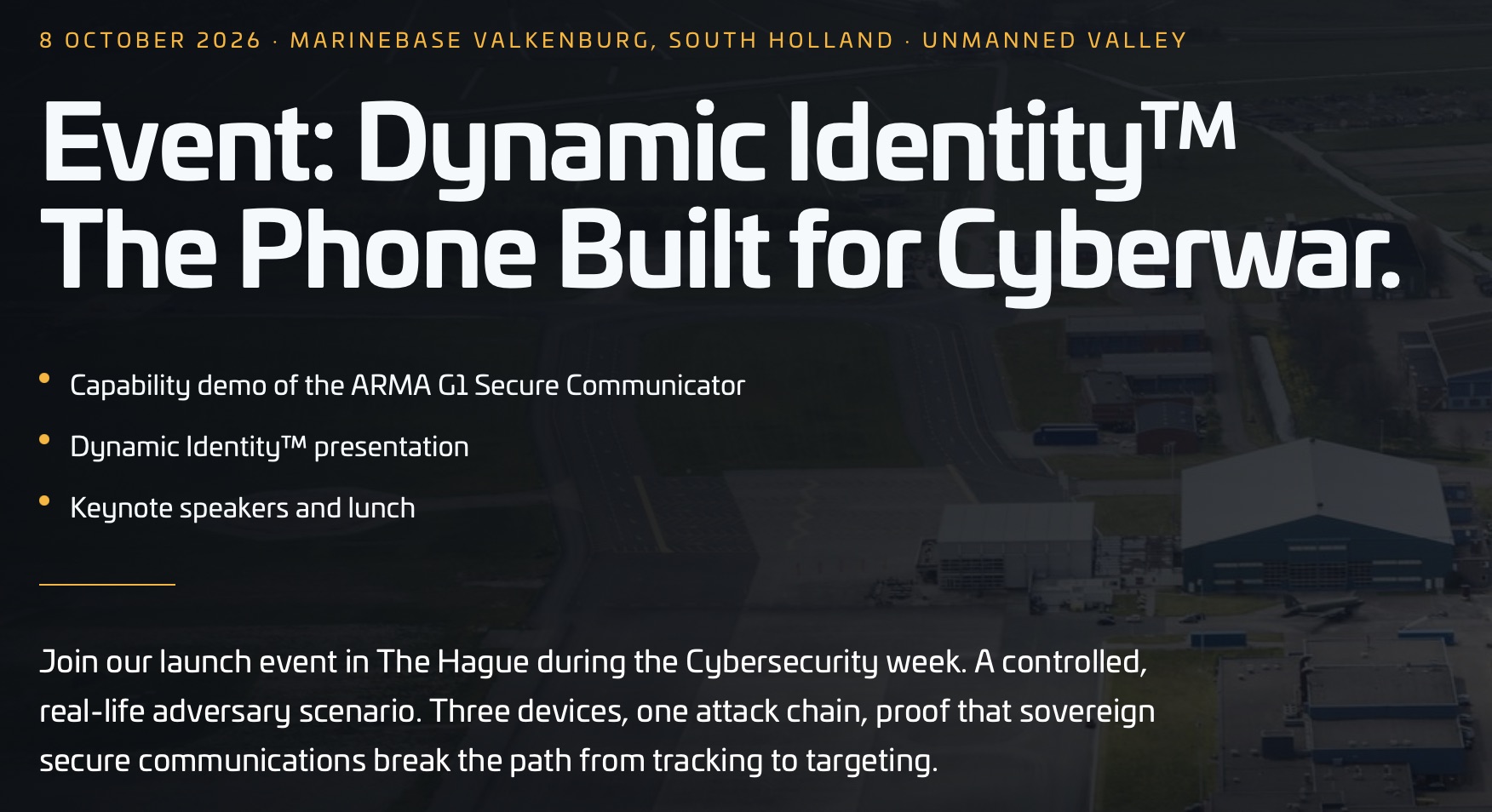
On 8 October 2026, ARMA Instruments will host a live demonstration during Cyber Security Week The Hague, showing how mobile identities can potentially be used to track devices and ultimately identify a physical target. The demonstration will also show how the ARMA G1 is designed to disrupt this tracking chain. Security Delta (HSD) supports the event as an endorsing partner, reflecting the importance of addressing both digital and physical aspects of secure communication.
Most secure phones focus on protecting communication itself through encrypted messaging, hardened operating systems and strong authentication. However, an adversary does not necessarily need access to the contents of a message to pose a security risk. Information about a device's identity and location can potentially be enough to track its user.
A phone number, for example, can provide a starting point for linking a person to the network identity of a device. If this information is not yet known, equipment such as an IMSI catcher can potentially be used to identify devices within a specific area.
Once a device has been identified, repeated observations can be combined to establish a movement pattern. This could reveal where someone is travelling, when they arrive at a location and where they may be most vulnerable:
- A phone number can lead to an identity.
- An identity can become a pattern.
- A pattern can reveal a location.
- A location can create an opportunity for targeting.
This demonstrates why secure communication involves more than encryption alone. Protecting the link between a digital identity and a physical location can be equally important.
Breaking the tracking chain
ARMA Instruments is a Dutch deep-tech company developing sovereign secure communication solutions based on zero-trust principles. Its ARMA G1 Mark III is a purpose-built secure phone for messaging and voice communication. The device combines dedicated secure hardware and post-quantum cryptography with an architecture that does not rely on central messaging or call servers.
A key element of the ARMA G1 is Dynamic Identity™. The technology enables the device to dynamically change its mobile network identity, including its IMSI and equipment identity, while communication continues. Instead of maintaining a permanent mobile identity that could potentially be tracked over time, Dynamic Identity™ is designed to make it more difficult to connect successive observations and establish a movement pattern.
By disrupting the connection between identity, movement and location, the technology aims to make tracking and physical targeting significantly more difficult.
Live demonstration during Cyber Security Week The Hague
During the event on 8 October, ARMA Instruments will demonstrate this approach live at Marinevliegkamp Valkenburg / Unmanned Valley in Katwijk.
Three operators using three devices will be exposed to a red-team attack scenario covering four stages:
- Identity capture – identifying the devices and their mobile network identities.
- Infection attempt – attempting to compromise the endpoint.
- Tracking and correlation – using repeated observations to establish a movement pattern.
- Physical targeting – using the collected information to identify a physical target with a drone.
The demonstration will show how a conventional permanent mobile identity can potentially be identified and correlated until it can be connected to a physical target. ARMA Instruments will then demonstrate how the ARMA G1 is designed to disrupt this chain.
Programme
In addition to the live demonstration, the programme includes keynotes, the official ARMA launch, presentations from partners and showcases of the U-Series and ARMA Messenger. The event will conclude with lunch.
Date: Thursday 8 October 2026
Time: 11:00–14:00 CET
Location: Marinevliegkamp Valkenburg / Unmanned Valley, Katwijk
Interested in attending?
Register for the event and join the live demonstration on 8 October.
Security Delta (HSD) supports the event as an endorsing partner. The event takes place during Cyber Security Week The Hague.
Photocredits: Istock/Rick_Jo
HSD Partners involved